AC Repair vs. Replacement: How to Know Which One You Actually Need
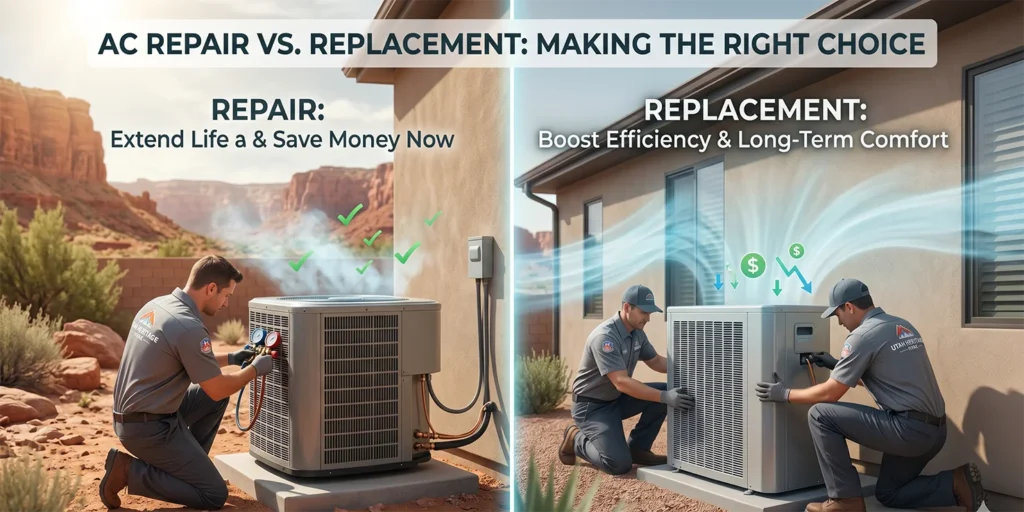
Your air conditioner stops working on a 110-degree afternoon in St. George. You call for a technician, they come out, and now you are faced with a number: the repair will cost $800, or you could put that toward a new system. How do you know which way to go?
This is one of the most common questions we hear at Utah Heritage HVAC. There is no universal right answer, but there is a clear way to think through it. Here is what we look at when we help a homeowner make this call.
The Age of the System
The single most important factor is how old the system is. A central air conditioner in Southern Utah has a realistic lifespan of 12 to 15 years with regular maintenance — and often less, because our climate runs equipment harder than almost anywhere in the country. St. George AC units run nearly continuously from May through September. That kind of load adds up.
If your system is under 8 years old and the repair is straightforward, fixing it almost always makes sense. If it is 12 years or older, the math starts to shift. You are likely looking at more repairs coming, declining efficiency, and a system nearing the end of its useful life regardless.
The $5,000 Rule
A simple rule of thumb used across the industry: multiply the age of the system by the repair cost. If that number exceeds $5,000, replacement is worth serious consideration.
A 10-year-old system with a $600 repair comes out to $6,000 — on the fence. A 6-year-old system with the same repair is $3,600 — repair it without question. A 14-year-old system with an $800 repair is $11,200 — time to have a serious conversation about replacement. This is a guideline, not a rule, but it gives you a useful starting point before emotion or urgency drives the decision.
What Failed and Why It Matters
Not all repairs are equal. A failed capacitor or a clogged drain line is a cheap, routine fix that says nothing about the overall health of the system. A failed compressor on a 10-year-old unit is a different situation entirely — the compressor is the heart of the system, and replacing it on aging equipment rarely makes financial sense.
The components to pay close attention to:
- Compressor failure — expensive to replace, often a signal to retire the system
- Heat exchanger cracks — a safety issue on furnaces, typically warrants replacement
- Refrigerant leaks on older R-22 systems — R-22 is no longer manufactured and the cost of charging these systems has become significant
- Multiple component failures in a short window — a sign the system is deteriorating broadly
Efficiency and Your Energy Bill
Older systems run at significantly lower efficiency ratings than modern equipment. A system installed 12 years ago might have a SEER rating of 10 or 11. Current systems run at 16 to 20 SEER or higher. In Southern Utah where your AC runs for seven months, that efficiency gap shows up clearly on your power bill every single month.
If your energy bills have been climbing and your system is aging, part of what you are paying for is the inefficiency of old equipment. A new system often pays for a portion of its cost through reduced utility bills over time.
The Southern Utah Factor
Southern Utah puts more stress on HVAC equipment than most climates in the country. The combination of extreme heat, long cooling seasons, and the elevation difference between St. George and Cedar City means systems here wear faster than national averages suggest. A system that might last 18 years in a mild climate may reach the end of its useful life at 12 or 13 years here.
This is worth keeping in mind when you are evaluating a repair. The expected remaining life of your system in this climate is shorter than you might assume.
When Repair Is Clearly the Right Call
Repair makes sense when the system is relatively young, the failed component is not a core part of the system, and the cost is reasonable relative to what a replacement would run. If your system is under 8 years old, well-maintained, and the repair is under $500, fix it without hesitation.
When Replacement Is the Smarter Move
Replacement makes sense when the system is 12 or more years old, the repair involves a major component, you have had multiple repairs in the last two or three years, or your energy bills have been steadily rising. Sometimes the honest answer is that you are putting money into a system that is on its way out regardless.
A new system installed correctly and sized properly for your home will run more reliably, cost less to operate, and come with manufacturer warranty coverage.
The Only Way to Know for Certain
No article can tell you what the right answer is for your specific system in your specific home. That requires someone to actually look at it — check the age, assess the component that failed, evaluate the overall condition, and give you an honest read.
That is exactly what a diagnostic visit is for. We come out, look at your system, and tell you what we see — including when we think the honest answer is replacement rather than repair. We are not going to recommend a repair just to get the job if replacement is clearly the better path for you.
Give Us a Call
If your AC is struggling or has stopped working, we are here. We serve all of Washington County and Cedar City and can typically get out to you the same day. We will assess your system honestly and walk you through your options before any work begins.
Call or text us at 801-661-5412 — we are happy to talk through what you are dealing with before you even book anything.